Mobile Crane Types: What to Know Before You Book One in UAE
The Museum Job That Was Never a Mobile Crane
A client from a museum called. He said he needed a mobile crane. We went through the full process confirmed the specs, arranged the machine, got everything ready to deliver.
Then we found out he needed a spider crane.
Not because the lift was wrong. Not because the weight was wrong. Because a mobile crane cannot go inside a museum. It is too big. A spider crane is compact, quiet, and built exactly for tight indoor environments like that. Same lifting job, completely different machine.
The client called it a mobile crane because that is the only word he knew. He was not wrong about what he needed he was wrong about what it was called. And by the time we found out, everything was already arranged.
This happens more than people think. The word “crane” covers a lot of machines. If you do not know which one fits your site, say that upfront. It saves everyone time.
The International Client and the Incomplete Brief
Right now I am dealing with a job from an international client. He needs a mobile crane to move crates from one area to another same street, short distance. He gave me the crate dimensions and weight. That is all.
No exact location. No photos of the site. No confirmation of whether a crane can even park there. No clarity on road access. I do not know if there is a parking area, if the road can take the crane’s weight, or if there are any overhead obstructions cables, trees, structures between the crane position and the lift point.
Before any crane moves, I need to know the exact site. Not the street name the exact spot. Because a crane does not just need a destination. It needs a parking position, a swing radius, and a clear path from where it sits to where it lifts.
If you are calling a rental company with a crane job, send the location first. Photos help even more. A site visit is best. The more information you give upfront, the faster the job gets done and the safer it is for everyone.
Why “I Need a Mobile Crane” Is Not Enough Information
Both of these situations came from the same problem. The client knew what they wanted to lift. They did not know which machine was right for the environment.
A crane rental company needs to know:
- What is the load: weight, dimensions, centre of gravity if it is an odd shape.
- Where is the site: exact location, road access, any overhead obstructions, available parking or standing area for the crane.
- What is the environment: outdoor open space, indoor, narrow street, soft ground, near a building or structure.
- What is the lift radius: how far horizontally from where the crane stands to where the load needs to go.
- What is the lift height: how high does the load need to go at its highest point.
Without these five things, no rental company can confirm the right machine. They can give you a price but they cannot guarantee the machine will work on your site.
Types of Mobile Cranes and When to Use Each
All Terrain Crane
This is the most versatile crane in the mobile crane category. It can drive on public roads at normal speeds and it can also handle rough, uneven ground on site. It has multiple axles and a powerful all-wheel drive and all-wheel steering system.
Use an all terrain crane when your job involves travelling on public roads to reach the site and the site itself is not flat or fully prepared. Construction projects, infrastructure work, and jobs in areas with mixed road and off-road access are where this crane fits best. Capacity ranges from around 50 tons to several hundred tons depending on the model.
In UAE, all terrain cranes are common on large construction sites and industrial projects where the crane needs to travel through the city and then operate on rough ground.
Rough Terrain Crane
A rough terrain crane is built only for off-road work. It cannot drive on public roads at speed it moves slowly and is usually transported to site on a lowbed trailer. On site, it handles very rough and uneven ground well.
Use a rough terrain crane when the site has very difficult ground conditions soft soil, steep gradients, unprepared surfaces and the crane does not need to travel between multiple road locations. Capacity is typically in the 30 to 130 ton range.
If your site is a large outdoor construction area with no need for road travel, a rough terrain crane gives you better stability than an all terrain crane at a lower cost.
Truck Mounted Crane
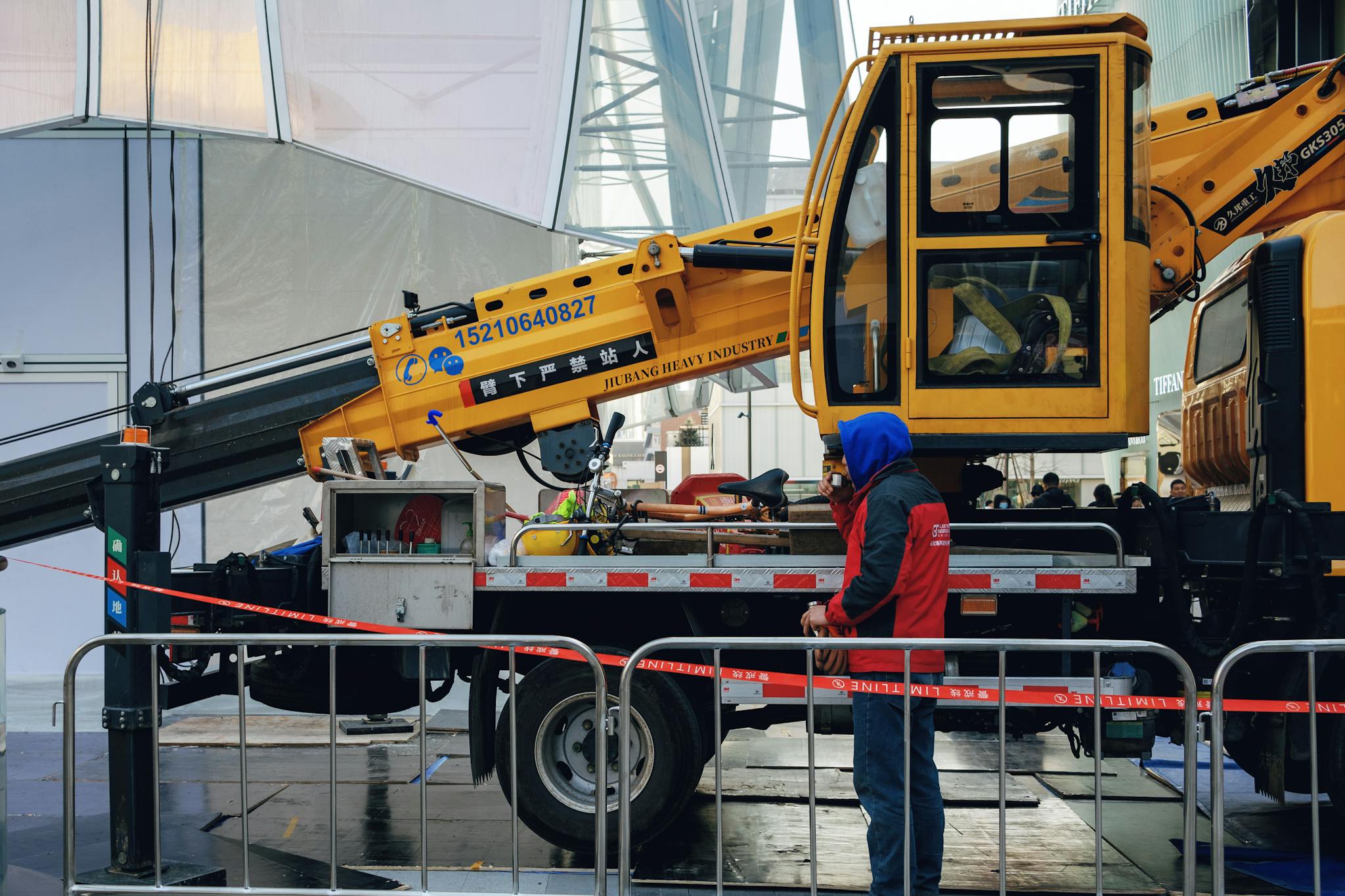
A truck mounted crane is a crane fixed on a standard truck chassis. It drives on public roads like a normal truck. Setup on site is fast. It is the most common crane for jobs in urban areas moving materials, loading and unloading, maintenance work on buildings.
The limitation is ground condition. A truck mounted crane needs a solid, level surface. It cannot work on soft or very uneven ground. It also has a smaller footprint than an all terrain crane, which makes it useful in tight urban spaces where a larger crane cannot fit.
In UAE, truck mounted cranes are used heavily for logistics, construction material handling, and maintenance jobs in cities like Dubai and Abu Dhabi.
Spider Crane
A spider crane is compact and runs on tracks. It can fold down to fit through a standard doorway, which makes it the only crane option for indoor environments. Museums, hotels, shopping malls, airports anywhere a standard crane cannot physically enter.
Weight capacity is lower than mobile cranes typically up to 3 or 4 tons on most common models but for indoor precision lifts, nothing else does the job. It is also quiet and produces no fumes, which matters in sensitive environments.
Always check if the job is indoor or in a space with restricted access before you assume a mobile crane is the answer. If the site has a door, a low ceiling, or a sensitive environment, ask about the spider crane first.
The 100 Ton Crane Beside Our Office
There was a construction site next to our office. A 100 ton crane was working. At the end of the day the operator left the boom fully extended and switched off the machine.
Next morning he came back and started closing the boom without first opening the outrigger jacks. The jacks are what stabilise the crane when it is working they spread out wide to hold the crane steady against the weight of the boom and the load.
With the boom extended and the jacks not deployed, the counterforce from closing the boom pushed the crane body upward. The crane shifted. The boom hit the building next to it.
The boom tilted. The building was damaged.
This was not a machine failure. The machine was fine. This was a procedure failure. One step skipped in the wrong order caused a serious accident on a live site.
Safety Rules That Prevent Expensive Mistakes
- Never leave the boom fully extended when shutting down. Lower it to the rest position before switching off.
- Always deploy outrigger jacks fully before operating the boom. Check that each jack is on solid ground and fully extended before any lift begins.
- Check overhead clearance before swinging the boom. Buildings, cables, trees, and structures that look far away can be inside the swing radius.
- Never operate beyond the rated capacity. Every crane has a load chart. The capacity changes depending on the boom angle, the boom length, and the radius of the lift. Read the chart before every lift.
- Do a site walk before setup. The operator and the lift supervisor need to walk the site together, confirm the crane position, confirm the swing path, and identify any hazards before the machine moves.
- Ground conditions matter. Soft or wet ground can shift under the weight of the crane and the load, especially when the boom is extended. If the ground is not confirmed solid, use mats or plates under the outrigger pads.
What to Send Your Rental Company Before Anything Moves
Before you call or message a crane rental company, have this ready:
- Exact site location with photos if possible.
- Load details: weight, dimensions, shape.
- Lift height and radius: how high and how far from the crane position.
- Site environment: indoor, outdoor, road access, ground condition.
- Any overhead obstructions: buildings, cables, structures near the lift area.
- Timeline: how long the crane is needed and what hours it will operate.
The more of this you send upfront, the faster you get the right machine at the right price. Missing information always causes delays and sometimes it causes the wrong machine to show up on site.
Contact Us
If you have a crane job and you are not sure which machine fits, contact us before you book. Send us the site details and we will help you figure out the right machine for the job.
Reach us at [email protected] or call +971 55 203 3746.